welcome to my court
Josephine KimProduct designer · Cornell Information Science · graduating Dec 2026
Viewpoint Vault
A qualitative research study exploring how echo chambers form at Cornell, and how anonymous pre-discussion reflection could make room for perspectives that often remain unspoken.
How Are Echo Chambers Created and Reinforced at Cornell?
College is supposed to expose you to more ideas. A lot of the time it does the opposite.
Social circles, academic tracks, algorithmic media, and classroom norms can quietly produce ideologically homogeneous environments. We focused on upperclassmen because they have had the most time to settle into routines, majors, and friend groups, which makes long-term patterns easier to see.
The problem was never that students disagreed with each other. The more interesting question was the gap between stated values and lived behavior.
Why do students who say they value diverse viewpoints still often remain silent when they encounter disagreement?
The question that framed the project
That framing pushed the study toward social, environmental, and behavioral conditions rather than opinions themselves. We wanted to understand the conditions around speaking, not the content of what was said.
Three Methods, One Behavior
Each method got at something different: what students say, what they notice day to day, and what actually happens in class.
- 01
Contextual Interviews
9 Cornell upperclassmen, recruited by word of mouth, on awareness, avoidance, media, and social circles.
- 02
Diary Study
9 upperclassmen, five days of end-of-day reflection, 33 entries analyzed through thematic coding.
- 03
Rapid Design Ethnography
4 participants shadowed across 3 classes and 1 public speaker session, with short post-session interviews.
- 04
Synthesis
Thematic analysis across all three methods, surfacing three themes and a shared set of user needs.
- 05
Design
Three research-backed design goals translated into a two-sided pre-discussion intervention.
We began with a literature review and contextual interviews with nine Cornell upperclassmen recruited by word of mouth. The interviews explored awareness of echo chambers, how students seek out or avoid differing perspectives, the role of social groups, media consumption, and comfort discussing polarizing subjects.
Thematic coding surfaced consistent patterns: a preference for like-minded peers, avoidance of polarizing topics, heavy reliance on algorithm-driven news, and limited awareness of how narrow those information environments had become.
Capturing What Interviews Miss
Echo chambers usually aren't one big moment. They build up over ordinary days.
Interviews capture what people remember and are willing to articulate. Echo chambers are built out of the things people do not think to report: repeated exposure, habitual media, comfortable conversations, and small moments where someone decides whether or not to speak. A diary study let us observe those moments closer to when they happened.
We recruited nine Cornell upperclassmen through email and peer outreach, all active social media users enrolled in at least one social or political course. Each completed a short structured entry once a day for five days, submitted between 7pm and midnight to encourage end-of-day reflection. In total we collected 33 entries.
- Encounters with differing viewpoints
- Conversations around ideological topics
- Comfort expressing their own opinions
- Media consumption and where it came from
- Moments where beliefs were challenged
- Awareness of being inside an echo chamber
Entries mentioning comfort, by setting.
Reinforcement outweighed challenge four to one.
How participants responded when a belief was tested.
Feelings named across the 33 diary entries.
The most discussed topics across entries were tariffs and climate change, followed by Cornell funding, AI, universal basic income, minimum wage, and Israel and Palestine. What mattered less was the topic and more the pattern around it: media reinforced beliefs far more often than it challenged them, and comfort tracked closely with agreement.
Observing the Social Dynamics
The diaries showed what people thought on their own. We still needed to see what happened in actual classrooms.
We ran a rapid design ethnography with four Cornell upperclassmen, shadowing them across three classes and one public speaker session. Two researchers observed each session to keep notes accurate and perspectives plural, documenting participation through typed notes and drawings of the space.
- Who spoke and how often
- Who stayed silent
- Participation patterns across the room
- How disagreement was received
- Classroom and social cues
- Spatial behavior and seating
Short unstructured interviews afterward gave participants room to reflect on moments of ideological reinforcement or exclusion, and to co-ideate possible responses with us. We deliberately used the interview guide lightly so the conversation could move where the participant wanted it to go.
One unexpected pattern: humor lowered the stakes of participating. That observation later became the Food for Thought prompts in the design, lighter questions that warm a class up before heavier ones.
Three Things the Research Made Clear
When we coded the interviews, diaries, and observations, they all pointed to the same story.
Silence doesn't mean agreement
A few voices frequently dominated class conversation while other students participated by nodding, agreeing quietly, or not speaking at all. Silence often looked like reluctance to disrupt the dominant viewpoint rather than an absence of opinion.
Disagreement carries social risk
Students described holding back when their views differed from the majority, because speaking could feel uncomfortable, confrontational, or simply not worth it in the current climate.
Students wanted anonymity
Anonymity surfaced repeatedly and unprompted as a way to reduce the perceived consequences of disagreement. Several students described wanting to submit a take on the reading before class without their name attached.
The barrier wasn't necessarily having a different opinion. It was feeling safe enough to express it.
Synthesis takeaway across all three methods
Students wanted diverse dialogue. Existing classroom structures simply did not make participation feel low-risk, so the easiest and safest option was to stay quiet.
From Insight to Design Principles
Every design decision after this goes back to one of these three findings.
Expose students to diverse viewpoints
Students rarely encountered opposing views, even when they said they were open to them.
Surface a broader range of classmates' perspectives before the discussion begins.
Create space for dissent
Students stayed quiet when their views clashed with perceived group norms.
Anonymous participation lowers the social cost of disagreeing.
Prompt reflection before consensus
The diary study showed that reflection alone raised awareness of ideological patterns.
Require a personal response before any classmate responses become visible.
Viewpoint Vault
An anonymous pre-discussion tool for classes: students reflect on their own first, and professors see the range of opinions before class starts.
The prototype is the outcome of the research, not its starting point. It is a two-sided system because the research surfaced two different problems: students needed a lower-risk way to contribute, and instructors needed visibility into perspectives that raised hands never reveal.
Reflect → submit anonymously → explore classmates' perspectives
Create discussion → gather anonymous responses → identify contrasting views → facilitate
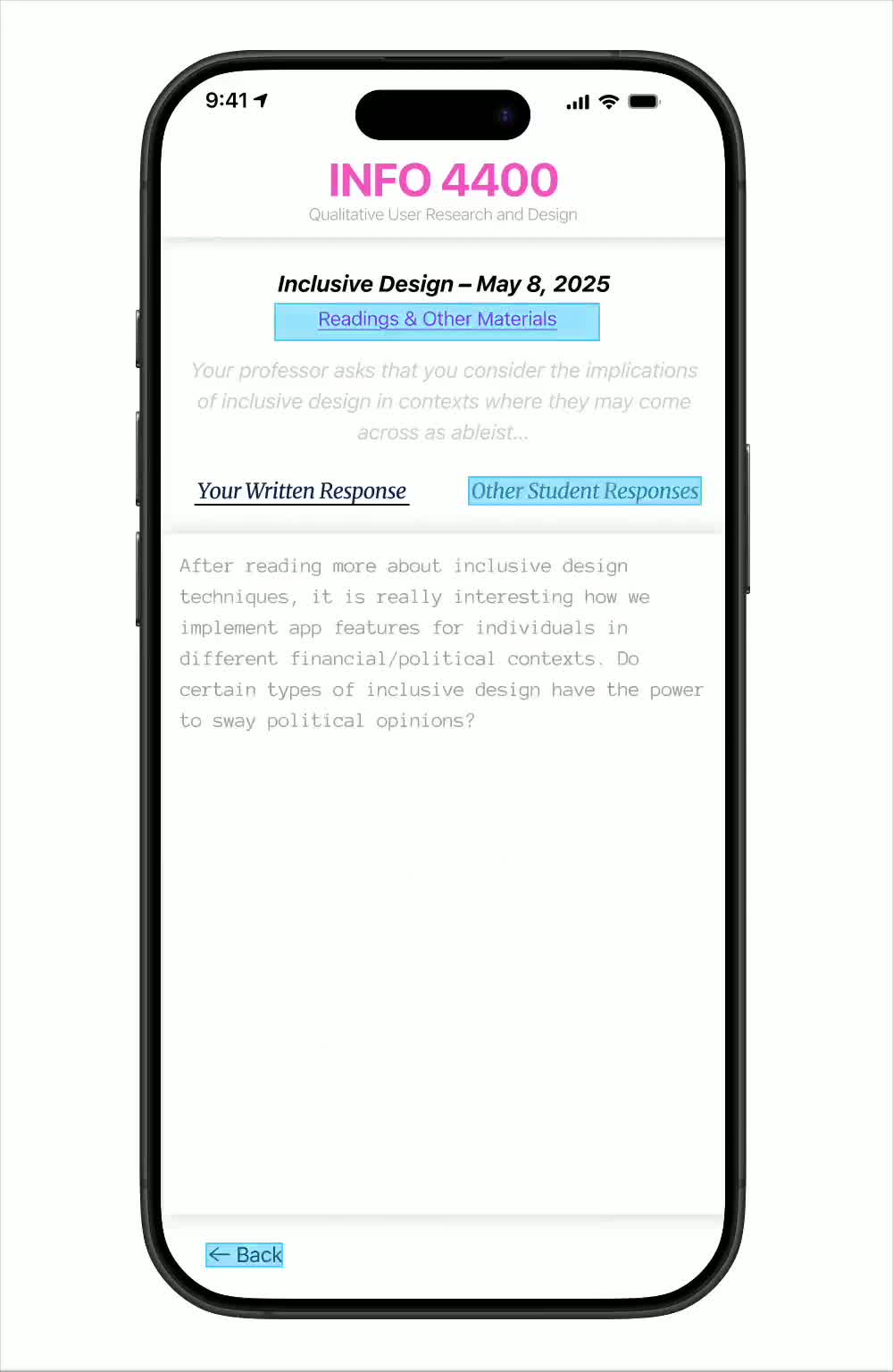
Student Flow: Reflect Before Seeing the Room
You write down what you think before you see what everyone else thinks. That order is on purpose.
- Browse enrolled classes
- Open a class discussion and its materials
- Read the professor's prompt and readings
- Write and submit a personal response
- Only then, explore anonymous classmate responses
- Move through the rest of the class discussion content
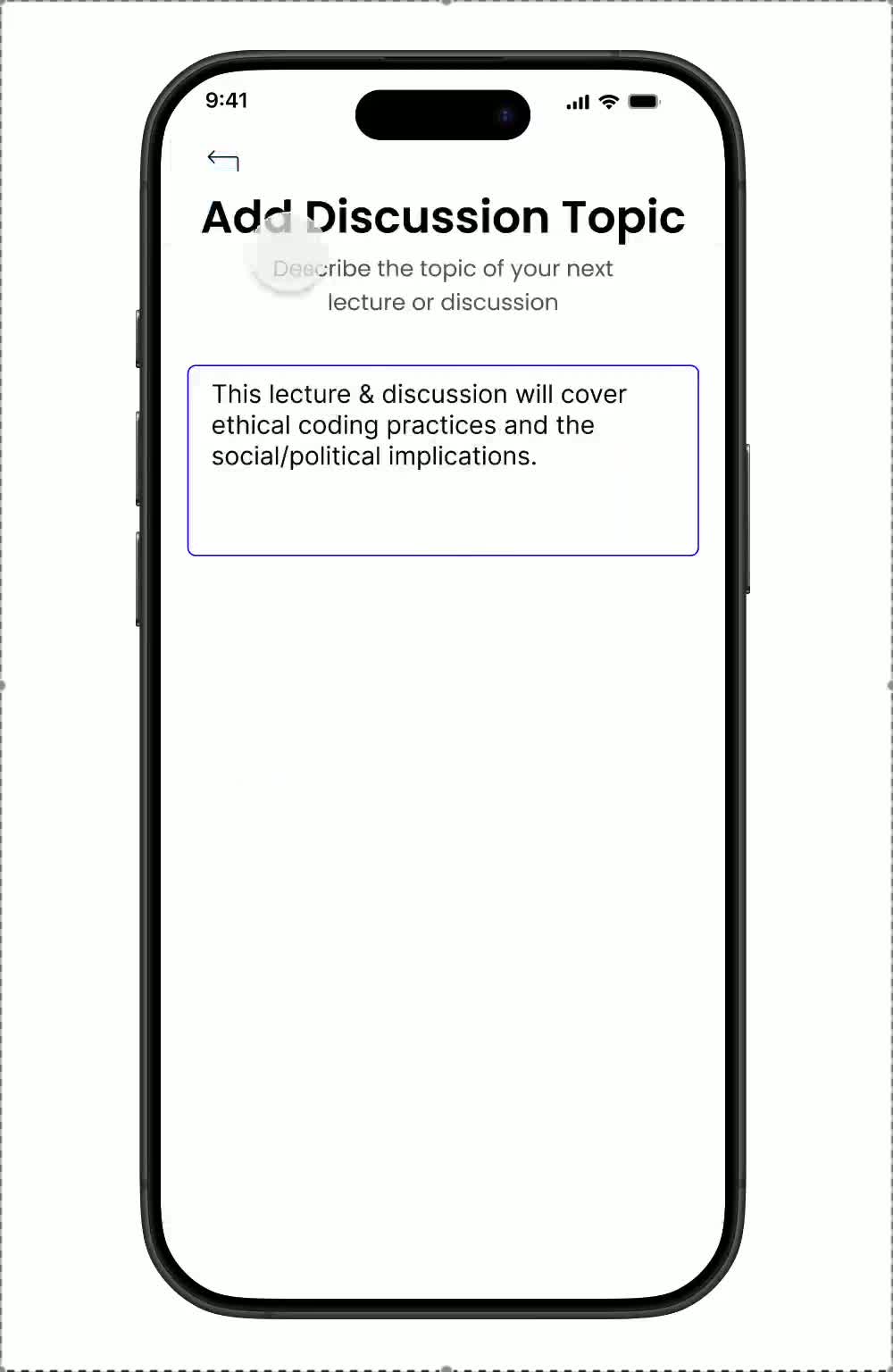
Professor Flow: See Beyond the Loudest Voices
Professors get a look at opinions that might never come up from raised hands alone.
- Browse and manage their classes
- Add or edit readings and materials
- Create a discussion topic for an upcoming class
- Add optional Food for Thought reflection questions
- Review anonymous student responses in one scannable view
- Use contrasting or underrepresented takes to plan the discussion
Our observations showed that instructors often steer discussion reactively, responding to whoever is willing to speak. The same few hands go up, and the conversation follows them. Viewpoint Vault gives instructors a pre-discussion view of the classroom's wider perspective landscape, so a broad range of views can be referenced without singling anyone out.
Why Two Sides?
It doesn't force anyone to debate. It just makes speaking up easier.
- Anonymous expression
- Independent reflection
- Exposure to diverse viewpoints
- Visibility into classroom perspectives
- Better discussion preparation
- Ability to surface underrepresented ideas
Neither side works alone. Anonymous student input without an instructor to use it is a suggestion box, and instructor preparation without honest input is guesswork. The value sits in the loop between them.
What This Project Did Not Prove
Our evidence is about the problem. We haven't tested how well the solution works long-term.
- Viewpoint Vault was never deployed longitudinally in real classrooms.
- The research focused on Cornell upperclassmen, a deliberately narrow population.
- Anonymous systems introduce moderation and misuse considerations we did not solve.
- A digital tool cannot replace thoughtful instructor facilitation.
- Classroom layout, social dynamics, and instructor behavior still shape who speaks.
- Longitudinal research would be needed to know whether the intervention reduces echo-chamber effects over time.
What Qualitative Research Made Possible
The best design idea didn't come from asking students what feature they wanted.
It came from noticing the gap between what students said they valued, diverse perspectives, and what they actually felt comfortable doing in social and classroom environments. No one asked for an anonymous pre-discussion forum. The need for one showed up in the distance between stated belief and observed behavior.
Combining self-reported and observational methods surfaces things neither can catch alone.
Choose the method based on the behavior you need to understand, not on convenience.
Qualitative patterns become useful when they translate into stated design principles.
Some barriers are social and psychological rather than usability problems.
Knowing where a digital intervention helps, and where human facilitation is required.
Reflection prompts changed behavior during the study, which became the core design mechanic.
Viewpoint Vault became less about fixing echo chambers and more about designing a lower-pressure moment where perspectives that normally remain silent have a chance to enter the conversation.
Closing takeaway