welcome to my court
Josephine KimProduct designer · Cornell Information Science · graduating Dec 2026
Reimagining Digital Engagement for Local News
Competitive strategy and UX research for ABC Owned Television Stations.
How can a leading local news brand turn an already strong digital presence into a more connected ecosystem that drives discovery, engagement, and repeat behavior?
Project Overview
I compared four New York local news brands across YouTube, web, mobile apps, weather, and how people get from national news to local coverage.
At ABC Owned Television Stations I conducted an end-to-end competitive analysis of WABC/ABC7NY, FOX 5 NY, NBC New York, and CBS New York across YouTube, desktop web, news apps, weather products, and national and local news ecosystems.
The goal was not simply to identify what competitors were doing differently. I wanted to understand why those differences mattered to users, what behaviors they encouraged, and where WABC could strategically build on its existing strengths.
The research surfaced six opportunities across content packaging, video engagement, local discovery, weather utility, and monetization.
The Challenge
Local stations aren't just competing on the stories they cover anymore.
The same breaking story can now reach someone through YouTube, a news website, a livestream, an app notification, weather radar, or a national news platform. That fragmentation creates a different kind of product challenge.
WABC already had many of the right building blocks:
- A large digital audience
- Recognizable local franchises
- A 24/7 livestream
- A dedicated local app
- Strong local credibility
Where are competitors creating stronger digital habits, and where could WABC improve packaging, discovery, video engagement, weather utility, and monetization?
The reframed research question
The question was not whether WABC needed more features. The opportunity was to understand how WABC's existing touchpoints could work harder together.
Defining the Research
The brief was really broad, so first I turned it into five specific research questions.
YouTube Strategy & Packaging
How are competitors packaging local news for recognition and repeat viewing?
- Subscriber scale, posting frequency, video-library size
- Shorts versus long-form and livestreams
- Thumbnail systems, title styles, visual consistency
- Playlists and recurring franchises
Website & Video UX
What encourages a user to continue engaging after the first story?
- Homepage hierarchy and above-the-fold content
- Autoplay behavior, muted versus sound-on video
- Livestream visibility and pre-roll advertising
- Trending Videos, weather placement, newsletter and app prompts
Local vs. National Discovery
How easily can a national audience discover relevant local coverage?
- Local-navigation visibility and market directories
- Station pages and shared branding
- National-to-local routing and livestream pathways
- Location-relevant weather and breaking-news pathways
Weather App Strategy
How are competitors turning weather into a daily-use habit?
- Location personalization and onboarding
- Hourly forecasts, extended forecasts, alerts
- Dedicated Weather tabs, radar, interactive layers
- Storm tracking, live weather, integration with local news
Monetization & Engagement
Where in the user journey is monetization being introduced?
- Display advertising, pre-roll video, sponsored content
- Newsletter prompts and app acquisition
- Branded promotions
- Monetization around high-engagement moments
From Screenshots to Strategy
Collecting observations was the easy part. The harder question was: so what?
My research began expansively. I manually audited each competitor across multiple digital touchpoints, collecting screenshots, quantitative benchmarks, interaction patterns, publishing behavior, navigation structures, and qualitative observations.
Was not strategically meaningful because it looked different. It mattered if it made breaking news faster to recognize.
Was not valuable simply because it existed. Placement, autoplay behavior, and connection to surrounding content determined whether it contributed to engagement.
Was not automatically a retention strategy. It became one when personalization, forecasts, alerts, and interactive tools gave users a reason to return.
That distinction moved the project from a feature comparison into a study of user behavior and digital strategy.
WABC had the largest local YouTube audience, but competitors created stronger visual systems
All four channels covered pretty similar stuff. What was different was how each one packaged it.
Everyone published combinations of breaking news, crime, weather, interviews, livestreams, Shorts, and recurring news franchises. WABC already led the competitive set in local subscriber scale, so the opportunity was not audience acquisition from scratch. It was recognition.
| Channel | Subscribers | Video library |
|---|---|---|
| WABC / ABC7NY | 2.76M | 41K |
| CBS New York | 1.18M | 169K |
| FOX 5 NY | 978K | 26K |
| NBC New York | 803K | 13K |
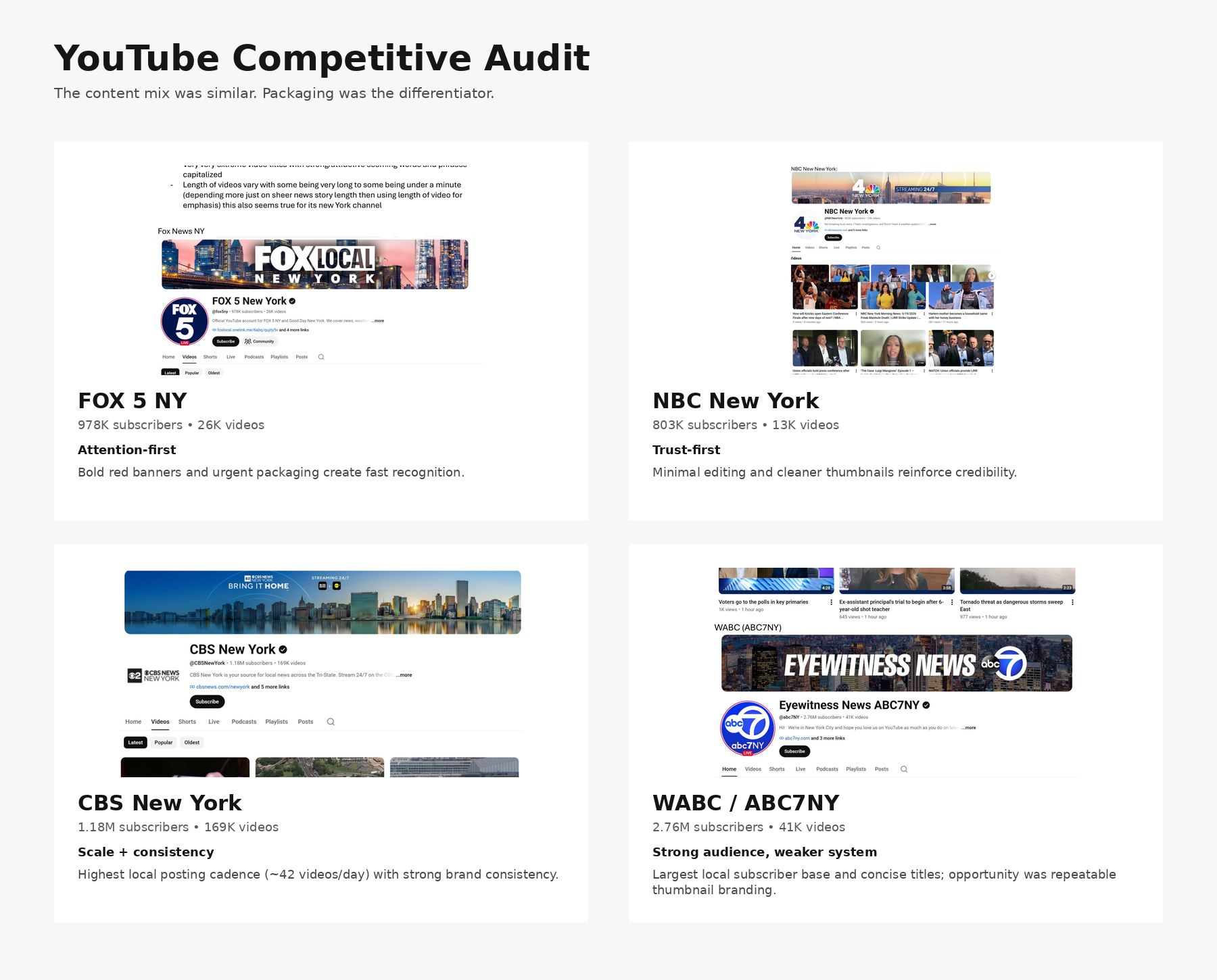
Bold red banners, prominent typography, urgent language and aggressively edited imagery. Strength: fast recognition. Tradeoff: louder, less polished, more attention-driven.
Minimal thumbnail editing with titles that read as straightforward story summaries. Strength: professionalism. Tradeoff: longer titles are less immediately clickable and can truncate.
Approximately 42 videos per day during the audit with a highly consistent identity. Strength: volume and recognizable branding. Tradeoff: packaging can feel less distinctive.
Largest local subscriber base, concise readable titles and recognizable franchises. Thumbnail treatment, logo placement and category packaging were less repeatable than competitor systems.
WABC did not need to copy FOX's clickbait style or CBS's publishing volume. I recommended building on existing strengths through repeatable thumbnail systems around recognizable franchises and content types.
- Breaking news: clean, urgent alert treatment
- Investigations and true crime: more distinctive serious-case packaging
- Car chases and live pursuits: high-energy local-video treatment
- Entertainment and OTRC: more personality-driven packaging
Video did not need to dominate the homepage. It needed to create the next step.
I expected big differences between video-first and article-first sites. It turns out almost everyone was still story-first.
Video supported the experience rather than replacing written stories. The important differences came from how video was incorporated into the user journey.
Above-the-fold newsroom livestream, muted autoplay, visible weather tools, prominent video, aggressive advertising and sponsored content. Highly active, but visually cluttered.
Playable video indicators across story thumbnails, muted livestreaming, pre-roll advertising, and weather paired with newsletter acquisition. NBC connected utility with retention.
Above-the-fold livestream, click-to-play video, Current Conditions and First Alert Weather, with advertising integrated discreetly into the content hierarchy.
24/7 livestream above the fold, muted autoplay, Trending Videos, pre-roll monetization on story video, a cleaner ad experience and a strong story-first hierarchy.
Rather than adding more video, I proposed connecting existing touchpoints into a clearer engagement path where each step gives an already-engaged user a logical next action.
- Top Story
The entry point for most sessions.
- 24/7 Livestream
Already above the fold and always available.
- Trending Video
Extends the session with adjacent coverage.
- Weather
Introduces a habitual daily-use reason to stay.
- Newsletter / App
Converts an engaged visit into a return path.
- Related Local Stories
Deepens the session inside local coverage.
Instead of acting like independent modules, livestreams, Trending Videos, weather, newsletters, and related coverage could function as one progressively deeper journey.
Finding 02
The strongest ecosystems made local coverage visible before users had to search for it
How easy is it to get from a national news brand to your local coverage? This is where the stations differed the most.
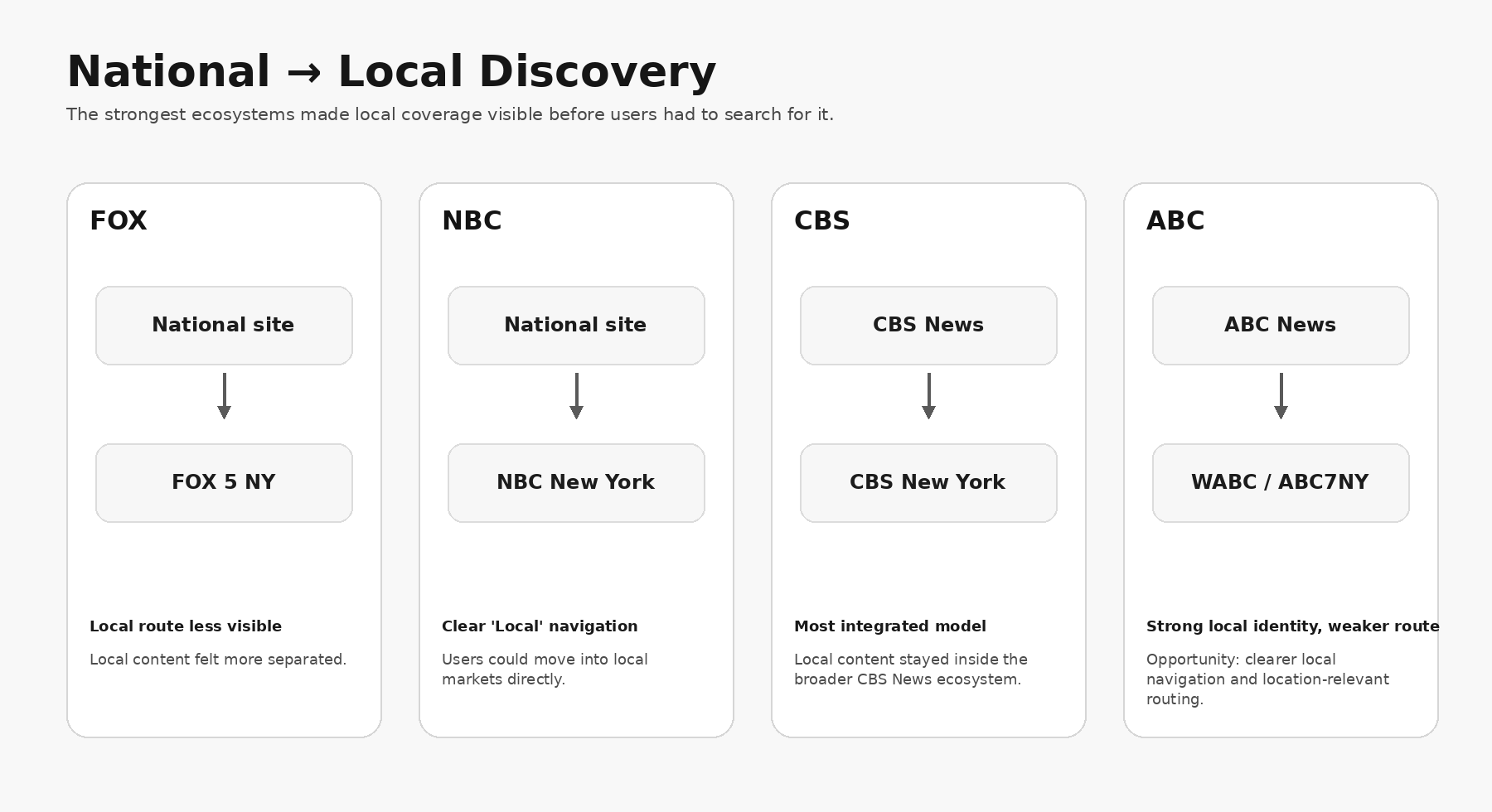
The national experience did not make FOX 5 New York easy to discover. Local content depended more heavily on users already knowing where to look.
Users could move from national news into different local markets directly through navigation. Visual identities differed, but the structural relationship remained clear.
CBS New York content existed inside the broader CBS News ecosystem rather than as a separate destination, so national distribution could elevate local reporting.
WABC had a strong standalone local identity, but discovery from ABC News into local-station experiences was less prominent than NBC or CBS.
I proposed strengthening the ABC News to WABC pathway through:
- A clearer Local Stations or Local News navigation entry
- WABC modules alongside relevant national stories
- Location-aware routing from weather and emergency coverage
- Direct pathways into local livestreams
- Direct pathways into local weather
Weather was one of the strongest opportunities for repeat engagement
Breaking news is unpredictable. Checking the weather is a daily habit.
People check weather when they wake up, commute, decide what to wear, make evening plans, travel, prepare for storms, and plan their weekend. That gives weather a fundamentally different product role from most news content. It can become a retention loop.
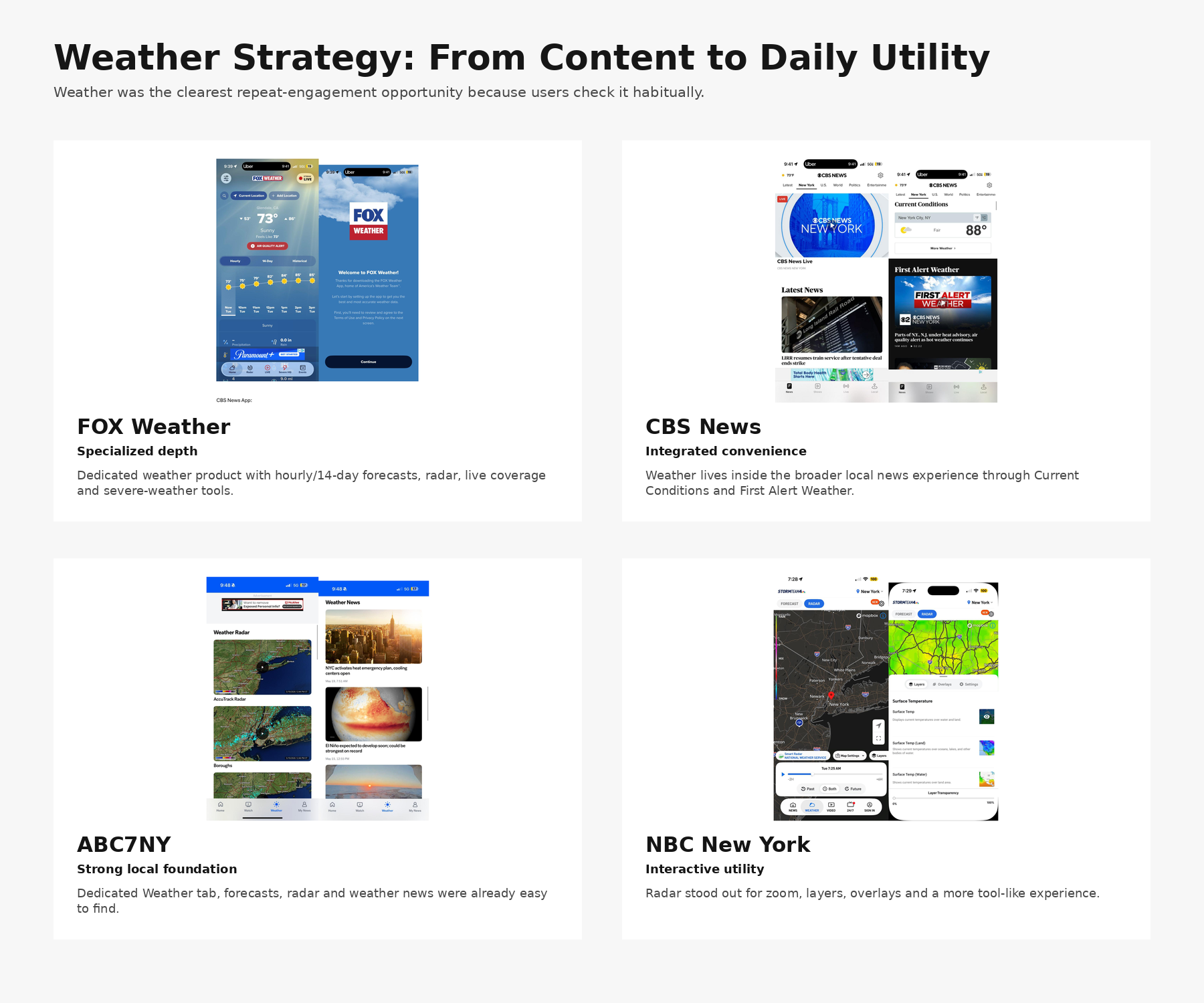
A dedicated product with hourly and 14-day forecasts, radar, live weather, severe-weather tools and event coverage. Tradeoff: users are divided between two experiences.
Current Conditions, First Alert Weather and local-market selection keep weather close to local news. Tradeoff: it feels like a news module rather than a complete utility.
Personalized onboarding, New York City location selection, Weather as a selectable interest, dedicated Weather navigation, hourly and daily forecasts, alerts, AccuWeather integration, AccuTrack Radar and weather news.
Radar behaved less like static content and more like a tool: zoom, layers, overlays, storm tracking, lightning, earthquakes and temperature plots.
ABC7NY did not need an entirely new weather product. It already had the right foundation. The largest opportunity was not discoverability. It was interactivity: making the existing radar experience more exploratory and tool-like, borrowing the underlying utility principles from NBC without copying the experience directly.
Weather content tells users what is happening. Weather tools give them a reason to come back.
The core insight
Monetization worked best when it followed engagement
FOX had a lot more visible ads and sponsored content: more ways to make money, but also more clutter.
WABC's comparatively cleaner experience created a different strategic opportunity. Instead of simply increasing ad density, monetization could be concentrated around moments where users had already demonstrated intent.
- Livestream viewing
- Story video
- Weather
- Newsletters
- App acquisition
- Recurring franchises and branded promotions
Competitive Positioning
After looking at each platform on its own, I stepped back to find the bigger pattern. Each competitor was good at something different.
Attention-first
Strongest at creating urgency through bold packaging, visible livestreaming, and high-energy presentation.
Trust-first
Strongest at maintaining polish while connecting useful products like weather with retention mechanisms.
Scale + structure
Strongest at publishing volume and integrating local content into a larger national ecosystem.
Local credibility
Strong audience scale, concise titles, recognizable franchises, a visible 24/7 livestream, a dedicated local app, and a strong local identity.
The goal was not to turn WABC into FOX, NBC, or CBS. It was to identify the mechanisms behind their strongest experiences and adapt only the pieces that strengthened WABC's own advantages. Learn from competitors without losing the identity users already trust.
Six Strategic Recommendations
I boiled all of that research down into six recommendations for WABC.
Match YouTube Packaging to WABC's Audience Scale
Create repeatable thumbnail systems for major franchises and content categories while preserving WABC's concise title style.
Test More Social-First Content Verticals
Explore high-interest local categories such as car chases, true crime, weather explainers, consumer scams, local-politics explainers, investigations, and entertainment. The goal is clickability without compromising credibility.
Build a Clearer Website Engagement Path
Connect existing strengths into one journey: Top Story, livestream, Trending Video, weather, newsletter or app, related stories.
Improve ABC News to WABC Discovery
Use national navigation, location-relevant stories, local modules, livestreams, and weather to expose national audiences more clearly to local content.
Turn Weather Into a More Interactive Utility
Build on ABC7NY's existing weather foundation with richer radar interaction and more tool-like functionality.
Balance Monetization With Trust
Focus advertising, promotions, newsletters, and app acquisition around moments where audiences have already demonstrated intent.
Connect the ecosystem.
Every competitor already had the basics: news, video, livestreams, weather, apps, and ads.
The competitive difference was not what features exist. It was:
- How recognizable is the content?
- How easily can users discover the next experience?
- What encourages another action?
- What creates a reason to return tomorrow?
Connect the ecosystem.
WABC already had many of the right individual building blocks. The opportunity was to make them reinforce one another across YouTube, website, livestream, weather, app, ABC News, and local content. A strong digital ecosystem is not a collection of channels. It is a system where each touchpoint makes the others more valuable.
Outcome
A broad research assignment turned into an actual strategy, covering packaging, UX, discovery, engagement, retention, and monetization.
Rather than recommending that WABC simply copy competitors, I identified the principles behind their strongest experiences and translated them into opportunities that aligned with WABC's existing strengths.
The project shifted the competitive question from "what are our competitors doing?" to "what behaviors are their digital experiences creating, and how can we design stronger ones?"
What I Learned
This project changed the way I approach competitive research. A competitive audit becomes valuable when it moves beyond documenting features and starts explaining behavior. For every difference I found, I learned to ask why it works, what behavior it encourages, what business goal that behavior supports, what tradeoff it introduces, and whether the same principle would make sense for our product.
Does this make the experience easier, clearer, more useful, or worth returning to?
Could this improve engagement, retention, discovery, or monetization?
Can the underlying idea be adopted without losing what makes the experience distinctive?
That intersection turned a broad competitor audit into an actionable digital strategy.
Public-facing product screenshots are shown for research and commentary. All trademarks and product imagery belong to their respective owners.